
AGADIR GREEN INDUSTRIES 02 / COUNTRY ADVANTAGE

Evidence before assumptions

Morocco: a serious manufacturing option, not a shortcut.

The strongest case combines local industrial demand, existing EU trade relations, public investment frameworks and the potential to create genuine industrial value. Price, skills, electricity, water and export treatment must be checked at project level.

International manufacturing and logistics cooperation

Why this country merits evaluation

Industrial policy, regional demand and international connections.

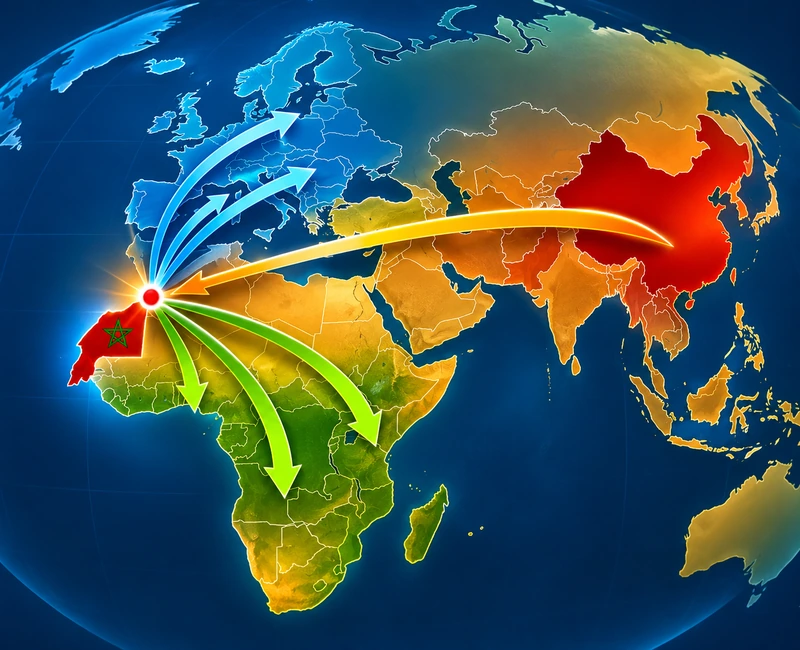
Morocco's investment charter is designed to support private investment and job creation. Its investment framework, production ecosystems and location alongside European markets make it worth assessing for the right product. [S02][S11]

  • Conditional investment support for eligible projects
  • European trade framework established since 2000
  • Rising share of renewable generating capacity
  • Industrial parks and one-stop administrative services
  • Existing manufacturing and agri-food ecosystems
01 / VERIFIED FACTS

What the public evidence actually supports.

Five attractive features, with the limitations that experienced industrial investors will test.

Investment charter
Up to 30%

Potential project support

Main scheme ceilings depend on eligible investment, qualifying stable jobs, project location and conditions. The amount is not automatic. [S02][S03]

EU trade relations
€62.2bn

2025 goods trade

EU–Morocco goods trade reflects a well-established commercial relationship. Individual shipments still need proper origin and customs analysis. [S01]

Installed electricity capacity
46.1%

Renewables in 2025

A share of national installed capacity, not the same as renewable generation or a factory's guaranteed green-electricity mix. [S04]

National target
52%+

Renewable installed capacity by 2030

A policy ambition that creates demand for equipment and services, while grid access and tariffs remain site-specific. [S04]

Industrial zone
64 ha

Current Drarga ZAI phase

Industrial infrastructure is listed at the Souss-Massa Industrial Acceleration Zone; the wider 305-ha programme is not the same as immediately available plots. [S05]

Independent review
OECD

Reforms—and real challenges

The OECD recognises improvements in infrastructure and value-chain integration while noting skills, regional differences and private-investment constraints. [S11]

Understanding investment incentives

Morocco's investment charter contains several mechanisms, including a main support scheme. Published eligibility guidance describes a route involving at least MAD 50 million investment plus 50 stable jobs, or another route based on creating more than 150 stable jobs without the same investment threshold. Other schemes exist with their own conditions; do not apply those thresholds indiscriminately. [S03]

Published premiums may reflect employment intensity, project location, priority activity and sustainability. Their cumulative maximum is subject to the scheme and official decision—not a price deduction automatically available to every investor. [S02]

Before presenting an incentive in a business plan: obtain the official eligibility position, eligible CAPEX definition, financing and employment requirements, awarding authority, convention, payment timing and clawback conditions.

Industrial parks and site selection

Morocco has established industrial zones and sectors such as automotive, electronics, agrifood and materials. But the right location for a low-water electronics workshop is different from the right location for a water-intensive recycling line. Souss-Massa’s official industrial estate listings include a marketed acceleration zone at Drarga. [S05][S06]

Industrial property should be assessed on zoning, permitted use, plot rights, electricity connection, water/wastewater capacity, transport cost, expansion room and skilled-labour access. Do not treat generic country-level infrastructure claims as a site utility guarantee.

Green power: promising, but contractual

The government reports that renewables accounted for 46.1% of installed electricity capacity in 2025, toward a target of more than 52% by 2030. Electricity self-generation is regulated, including under Law 82-21 and its implementing framework. [S04][S12]

For any proposed plant we need the actual grid connection, available capacity, commercial tariff, curtailment exposure, potential on-site generation and how energy origin can be evidenced. Installing solar panels does not automatically establish a zero-carbon product.

Operations, training and supply chains

Morocco’s industrialisation has created experienced manufacturing ecosystems, but local skills depend on sector and location. Investors should budget for commissioning, engineering support, training, language requirements, factory supervision and quality control. OECD research highlights productivity and skill challenges that cannot be solved by a headline wage comparison. [S11][S14]

Conditions that can change the result

Potential advantageWhat must be verified
Lower delivered manufacturing costsFull landed unit cost, yield losses, quality, utilities, freight, insurance and finance.
Public supportIncentive scheme, thresholds, contract, budget availability and payout conditions.
Renewable electricityConnection and supply contract, meter data, certificate recognition and price.
European accessCorrect preferential origin, HS classification, CBAM and product standards.
Regional labourQualified staff availability, turnover, upskilling and employer obligations.
Industrial siteTitle, zoning, wastewater, environmental approvals, permits and actual plot availability.

Test your assumptions in a scenario model ↗