SINOAFRICA GATEWAY BUSINESS ESTABLISHMENT IN AGADIR

From business idea to operating in Agadir.

Establishing a company in Morocco is only part of the journey. This guide explains the full route for entrepreneurs: validating an opportunity, setting up the legal entity, finding a suitable site, employing people and reaching customers in Morocco, Africa or the European Union.

We work as an independent commercial facilitator, bringing investors and local specialists together. We do not issue licences or promise subsidies. Our starting point is to understand the business, then assemble the information needed for an informed investment decision.

11connected stages from the first feasibility study to operating compliance
30%upper ceiling of certain investment-charter incentives, never automatic
64 hapublished area of the initial Souss-Massa industrial acceleration zone phase
2separate regulatory systems for China-based investment: outbound and Moroccan establishment
Official framework and establishment roadmap · See the referenced sources below.
01 / THE COMPLETE ROADMAP

How to establish and operate a business in Agadir.

Read the entire sequence here. The steps are connected, but they are not always strictly consecutive: bank preparation, site selection and regulatory applications often run in parallel.

How to use this roadmap: start with the commercial case and use each phase as a decision gate. Some investors will need a factory, others a trading or service subsidiary. The documents and permits are different, so the sequence must be adapted to the actual activity.

It is possible to incorporate a Moroccan company relatively early, but incorporation does not prove that the proposed operation can obtain its electricity, environmental approval or first customer. We therefore treat registration as one milestone in a larger establishment process.

01 / BEFORE YOU INVEST

Understand the business before registering the company.

The first decisions are commercial. Investors should establish who will buy the product, why local production improves the business model and whether the selected location can support the operation. Registration should follow—not precede—those answers.

01 / STAGE

Define what the company will actually do

A factory is not a business plan in itself. The first question is which customers the Moroccan operation intends to serve. A supplier of irrigation equipment selling to farms around Souss-Massa faces a different commercial reality from a manufacturer of electronic assemblies destined for EU customers. The products, required standards, delivery windows and after-sales obligations are different.

We begin with the intended goods or services, manufacturing process, expected annual volume, target prices, customer geography and the existing supply chain. An importer or distributor may need a trading subsidiary, while a capital-intensive industrial producer needs a site capable of carrying its equipment and emissions profile.

The initial investment brief should describe where the revenue will come from, the scale of the proposed investment, how much capital is available and who is authorised to make decisions. It is useful to distinguish the pilot stage from any later factory expansion. This prevents a large land commitment from being made when the initial market is still untested.

Decision point: identify a specific customer problem, a viable product and the minimum evidence required before money is committed.
02 / STAGE

Test costs and customers, not just wages

Morocco can offer a different balance of labour, transport, industrial services and access to nearby markets, but a lower wage does not automatically mean a cheaper finished product. Electricity tariffs, productivity, machinery maintenance, inland transport, import duties on components and compliance costs can reverse the apparent advantage.

For a realistic comparison, prepare a bill of materials and a process-cost model for the same finished product in China, in Morocco and—where relevant—in the EU. Include defects, warranty provisions, inventory carrying costs, shipping time and working capital. Ask customers whether they would actually order from the Moroccan entity and under which quality conditions.

The model should also test sales in the local market. Farms, food-processing businesses, construction companies, utilities and established manufacturers in Souss-Massa may need equipment, packaging, water systems, electrical products and maintenance. These are sectors to investigate, not confirmed purchase orders.

Decision point: proceed only when delivered cost, demand and payment terms make sense without assuming an incentive award.

03 / STAGE

Prepare the investment in the country of origin

For a mainland China-based investor, creating a Moroccan subsidiary is not the only regulatory step. China operates a separate outbound-investment framework, including procedures involving the National Development and Reform Commission, the Ministry of Commerce and the banks handling the foreign-exchange transfer. The exact treatment depends on the investor, destination, structure and type of investment.

A State Council outbound-investment regulation took effect on 1 July 2026. Revised NDRC administrative measures were issued in October 2026 and are scheduled to take effect on 1 December 2026. This means a company planning its investment in November must check the rules applicable on the actual filing date rather than relying on an old procedural guide.

The shareholder should first prepare a genuine ownership chart, board approvals, investment amount, funding source and intended business scope. Cross-border structures through Hong Kong or another jurisdiction still require substance and a review of who ultimately controls the investment. Capital-transfer arrangements should be examined with the remitting bank before signing commitments in Morocco.

Decision point: secure an appropriate China-side regulatory and banking pathway before promising to fund the Moroccan project.

02 / LEGAL ESTABLISHMENT

Turn the decision into a properly structured Moroccan company.

Company formation includes corporate ownership, legally valid documents, registrations and banking. A manufacturing investor must coordinate these tasks with the land, construction and environmental work rather than waiting until the company is registered.

04 / STAGE

Choose the right Moroccan legal structure

Many foreign investors examine a Moroccan limited liability company (SARL) for a conventional operating business. Larger projects or those expecting several institutional shareholders may consider a société anonyme (SA). A branch, a joint venture or a commercial arrangement with an existing Moroccan operator can be appropriate in other circumstances. No single structure is automatically best for every investor.

Ownership is only one part of the decision. The structure should allocate management powers, signing authority, financing obligations, intellectual-property rights, dividend policy, supply agreements and the position of minority shareholders. Shareholder agreements deserve special attention where technology, machinery or working capital will be provided by different partners.

For a foreign shareholder, legal advisers will need to confirm the permitted activity and whether any sector-specific restrictions apply. The documents also need to work in practice with a Moroccan bank, tax adviser, customer contracts and any subsidy application.

Decision point: approve a structure that is compatible with the future business model, not merely the cheapest incorporation procedure.

05 / STAGE

Complete company formation and registration

The Moroccan company-creation sequence starts with a proposed legal name and a name-availability certificate, usually referred to as the certificat négatif. The incorporation documents then set out the shareholders, registered office, business purpose and management. Company formalities can be organised through the competent registration services and electronic creation channels.

OMPIC describes the principal steps and documents for legal-entity creation. Registrations commonly result in a commercial registry number (RC), company identifier (ICE), tax identification and professional-tax registration. The precise sequence and required attachments should be checked for the type of company and filing channel in use. A name certificate is not a trademark registration.

Where a foreign company is a shareholder, the file normally requires an up-to-date corporate extract, constitutional documents and evidence that the signatory is authorised. Identity, beneficial ownership and any translation or authentication requirements should be established in advance. A physical address or accepted domiciliation arrangement is essential, but an office address alone does not permit industrial manufacturing there.

Decision point: receive verified corporate registrations and a practical post-incorporation compliance checklist.

06 / STAGE

Document the inward investment and open accounts

The Moroccan company will need banking arrangements appropriate to its activity. Banks examine the identity and ownership of the company, the intended transactions, the business model and the source of funds. Imported equipment, shareholder loans and equity contributions should not be treated as interchangeable without reviewing the relevant accounting, customs and foreign-exchange consequences.

Morocco has a foreign-investment convertibility regime administered under Office des Changes rules. Eligible investments financed and documented in foreign currency may benefit from mechanisms supporting transfers of income and capital, subject to the applicable rules and supporting evidence. This is why the record of the original inward payment matters from the beginning.

Prepare a funding schedule linked to the real project calendar. A company may need deposits for premises, equipment orders and staff before it has sales revenue. The financial model should include bank onboarding, payment lead times, exchange-rate exposure and a reserve for unforeseen setup costs.

Decision point: confirm how the business will receive, document, use and later repatriate eligible foreign investment proceeds.

03 / INDUSTRIAL READINESS

Get the location, people and supply chain ready for production.

Factory premises, electricity, water, permits, safety, imports and recruitment can have a larger effect on the launch date than incorporation. A robust feasibility file brings these requirements together before major commitments.

07 / STAGE

Check industrial land, utilities and environmental permission

The location decision requires more than choosing a plot on a map. A manufacturer should verify land title or lease rights, legal zoning, allowable industrial activity, road access, building conditions, fire safety, electricity capacity and water supply. The power supply needed for a light-assembly workshop is different from that of a factory with ovens, compressors or extensive refrigeration.

The Souss-Massa industrial acceleration zone near Drarga is a concrete location to assess. MEDZ publishes a 305-hectare overall programme and a first phase of 64 hectares. These figures describe the programme, not the quantity of plots currently available or the conditions of sale. The operator must confirm the specific premises, available lots, prices and utility connections in writing.

Industrial projects may also require prior environmental assessment under the applicable Moroccan framework. A proper technical file describes emissions, industrial wastewater, process chemicals, waste disposal, noise and mitigation. Where equipment is sensitive to interruptions or water quality, engineering studies should be completed before the purchase or lease becomes irreversible.

Decision point: obtain written evidence that the selected site can legally and physically host the proposed activity.

08 / STAGE

Determine eligibility for investment support before budgeting it

Morocco's Investment Charter is an important part of the country’s industrial-investment policy. The main mechanism may provide incentives of up to 30% of eligible investment expenditure for projects meeting specified conditions. The ceiling is not a standard rebate, and most business founders should not assume that their company will qualify.

Published conditions include one route based on a qualifying investment of at least MAD 50 million together with at least 50 stable jobs, and another based on more than 150 stable jobs. Other support schemes have different thresholds and sector or regional criteria. The applicable mechanism, eligible expenditure and approval process must be checked directly with the regional investment authorities.

For planning, prepare two versions of the investment case: one entirely without public financial support and another incorporating only support confirmed as available under the relevant scheme. The application should be supported by investment estimates, employment planning, a viable business plan and all required administrative documents. The project must respect the contractual conditions of any eventual investment agreement.

Decision point: treat public incentives as a potential improvement to feasibility, never the foundation of a weak business model.

09 / STAGE

Design the import, production and export chain

Morocco's relationship with the European Union offers a significant trade framework for industrial products. However, the EU–Morocco agreement does not allow a Chinese product to become Moroccan simply by passing through a Moroccan warehouse or by changing its label. Preferential origin must be established under the applicable product-specific rules and processing conditions.

Before ordering machinery or raw materials, identify the product's customs classification, the origin of every material and the transformation that will occur in Morocco. A robust cost model includes customs duties, import VAT where relevant, freight, insurance, certification, inspection, returns and the commercial delivery terms agreed with the EU customer.

EU product law also matters. Depending on the product, the manufacturer or importer may need conformity assessment, technical files, CE marking where applicable, chemical compliance or traceability. The EU Carbon Border Adjustment Mechanism entered its definitive regime in January 2026 for specified carbon-intensive sectors. Covered importers must consider authorisation, emissions reporting and certificate requirements under current rules.

Decision point: prove that the specific finished product is legally marketable and competitively priced at its destination.

04 / ENTERING THE MARKET

Move from opening day to stable operations and compliant export.

The project succeeds when the factory can manufacture to specification, deliver at competitive landed cost, pay its obligations and meet customer standards. Ownership of a Moroccan company alone does not provide those outcomes.

10 / STAGE

Recruit, train and commission the operation

A registered company cannot deliver orders without people, tested processes and documented responsibility. The operating plan should set out the number and skills of employees, working arrangements, health and safety measures, quality controls and training needs. In some sectors the difficult task is not finding general labour but preparing technicians to maintain, calibrate and troubleshoot imported machinery.

Local recruitment and training can be developed around the existing regional technical and vocational infrastructure. Foreign managers or specialists must separately verify immigration and work-authorisation conditions. A business trip, residence document and an employment entitlement are not the same legal status.

Commissioning should be treated as a controlled phase. Test the machinery, establish traceable production batches, obtain customer approval where required and confirm that the facility can meet delivery promises at a stable defect rate. Employment contracts, social-security registrations and payroll administration must be in place before full operations begin.

Decision point: demonstrate that the operation can produce safely, reliably and at the quality standard buyers require.

11 / STAGE

Operate compliantly and plan future expansion

The work continues after the first sale. Moroccan operations must organise accounting records, tax filings, payroll, social-security administration, corporate changes and sector-specific obligations. Importers and exporters need auditable records showing what was bought, transformed and shipped. Foreign-parent transactions require coherent contracts and suitable tax review.

Management reporting should focus on customer concentration, order backlog, yield, energy and water use, operating cash, quality claims and on-time deliveries. Expansion decisions should be based on demonstrated demand rather than on an optimistic forecast of the wider Moroccan or European market.

SinoAfrica Gateway can help coordinate the commercial process and introductions with qualified local providers. Legal opinions, tax positions, customs classification, land rights and environmental approvals must always be confirmed by the relevant professionals or authorities.

Decision point: establish a compliance calendar, performance baseline and evidence-led criteria for any second phase.

05 / THE REGIONAL PROPOSITION

Why a company should investigate Agadir.

Agadir can be a commercially meaningful location for selected activities. It should be assessed on its industrial customers, workforce, infrastructure and delivered cost—not on geographical slogans.

Regional demand gives industrial projects a starting point.

Souss-Massa has established activities linked to agricultural production, food and seafood processing, logistics and urban services. Equipment for water efficiency, cold-chain control, packaging, building systems, maintenance and energy optimisation may find regional customers. A credible project tests named buyers and annual demand rather than assuming every sector is automatically expanding.

These regional uses matter even when an entrepreneur eventually wants to export. A local customer base can reduce dependence on a single distant importer, support commissioning and provide feedback while a factory develops its export certifications.

of modern manufacturing activity
Solar-powered industrial facilities

Energy and water should be investigated from the first meeting.

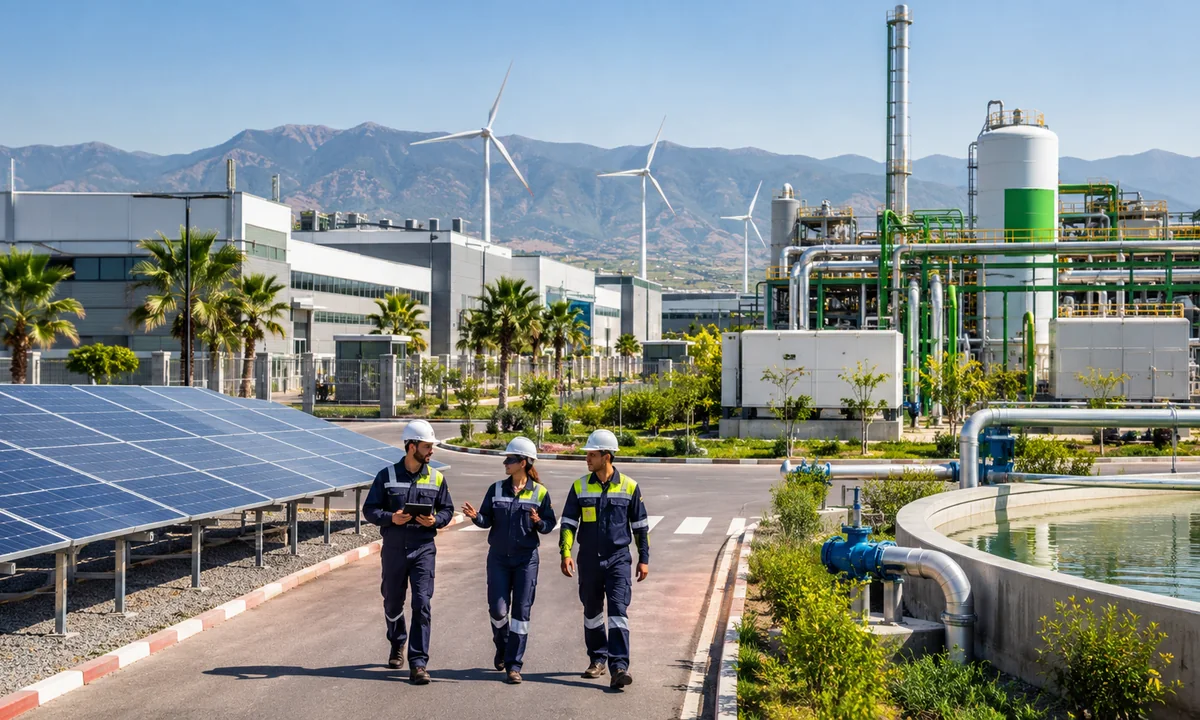
Green production can benefit from technologies that reduce electricity use, process water, leakage and waste. But the factory needs a site-specific utility proposal. The availability of sunshine is not proof that a company has access to inexpensive electricity, and a municipal water network is not automatically suitable for an industrial production line.

Potential investors should request engineering estimates for grid capacity, backup power, wastewater treatment, clean-water needs and environmental limits. The region's real challenges can also create a market for water treatment, solar equipment, monitoring systems and repair services.

Industrial property is an operating question, not a photograph.

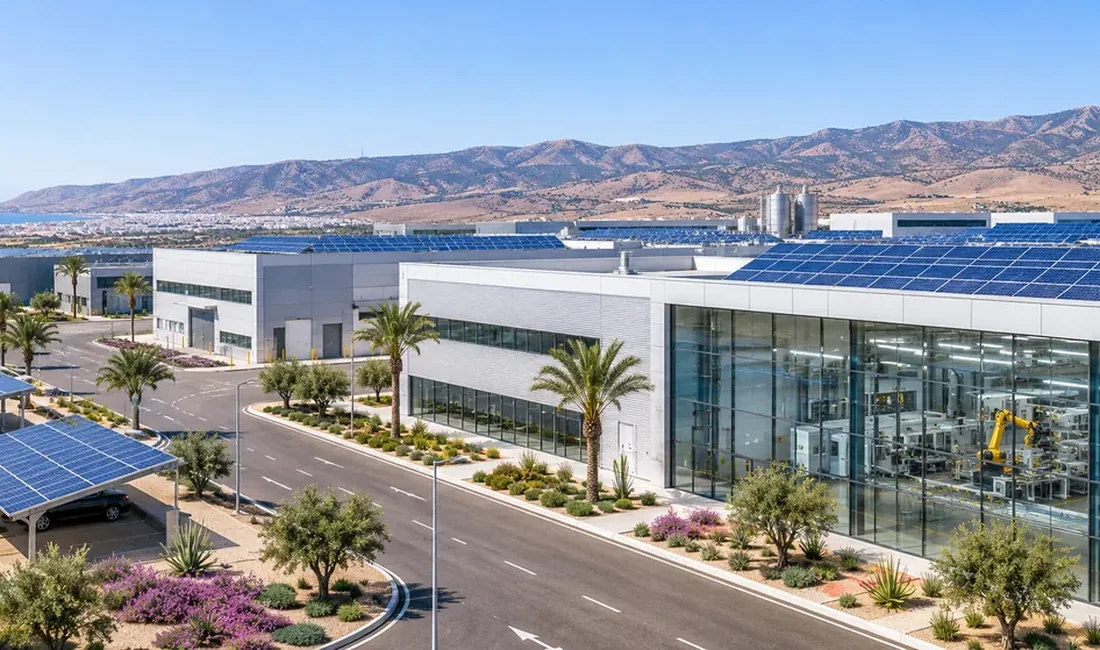
The 64-hectare first phase of the Souss-Massa industrial acceleration zone at Drarga is published by MEDZ within a wider 305-hectare programme. Industrial zoning and services are positive screening factors, yet they do not establish today's vacant plot inventory or the price of a specific factory.

Compare several premises where possible, including leasing an existing approved building. A smaller pilot can sometimes reveal more about real costs and supplier performance than a large property commitment made at the outset.

industrial campus landscape
06 / THE EUROPEAN CONNECTION

A production corridor to Europe must be built on proof.

The strategic benefit is not that Morocco is a shortcut around European rules. The benefit, when the product economics work, is having a properly established manufacturing operation near buyers with documented quality and origin.

view of international freight and logistics infrastructure

The delivered price is what matters to the European customer.

European importers compare the complete landed price, technical conformity and delivery reliability. A factory in Agadir should therefore request real quotations for road transport, port handling, sea freight, customs brokerage and storage for each product and route. Container availability, weekly sailing schedules and the distance to the customer's premises can matter more than an attractive map.

Any preferential tariff claim needs a product-specific origin analysis. Using Chinese machinery does not disqualify production in Morocco, but merely repackaging Chinese finished goods usually cannot create Moroccan preferential origin. In addition, EU safety, environmental and product laws apply regardless of marketing claims about sustainability.

Decarbonisation is also a compliance question.

For goods covered by the EU Carbon Border Adjustment Mechanism, importers must assess the emissions embedded in products and their obligations under the definitive regime introduced in January 2026. For manufacturers this means energy data, production records and potentially third-party verification become commercial inputs, not publicity material.

Companies should build traceability into manufacturing early, especially in metal, chemical or other regulated chains. Verified low-carbon production may strengthen their position with customers, but a renewable-energy marketing statement cannot replace the required underlying measurements.

image of international industrial partners collaborating
07 / HOW SINOAFRICA GATEWAY WORKS

A local commercial partner for a complex cross-border project.

We organise the conversation around a specific investment, not a generic package that assumes every company has the same requirements.

First, we understand the business.

When a company contacts SinoAfrica Gateway, we start with its product, existing operations, ownership, likely capital and intended buyers. We can then identify which local questions have to be answered first and which professional advisers or public agencies should be involved.

Some enquiries are better served by a distributor or a pilot operation. Others justify comparing industrial sites or exploring a joint venture. Presenting the correct route at an early stage can save money and months of avoidable work.

Then we coordinate an evidence-led path.

Our potential role includes introductions to relevant commercial partners, assistance in organising site investigations, gathering preliminary quotations and helping structure discussions with qualified professionals. The relevant government agencies remain responsible for registrations, decisions and permits.

We do not guarantee industrial land, financing, government incentives, visa status or specific tax treatment. The company remains responsible for its investment decision, supported by independent legal, technical and financial due diligence.

08 / QUESTIONS INVESTORS ASK

Practical answers before the first meeting.

These are common commercial and regulatory concerns. A precise answer still depends on the activity, the ownership structure and the intended industrial site.

Can a Chinese-owned company be established in Morocco?

Foreign ownership is possible for many ordinary commercial and industrial activities, but the proposed sector, legal vehicle and any licensing restrictions must be reviewed. For mainland China-based capital, the Chinese outbound process must also be considered separately.

Do we need a factory before registering a company?

Not necessarily. Registration and site development are different workstreams. However, the business should validate industrial zoning, site feasibility and utility needs before entering an expensive property commitment.

Can manufacturing in Morocco make an export eligible for EU preferences?

Potentially, where the finished goods meet the applicable product-specific preferential-origin rules. A Moroccan address or invoice is not enough. Customs classification and actual transformation determine the relevant assessment.

Can the government pay 30% of the investment?

The figure is a published maximum under certain support schemes, not an automatic entitlement. Qualifying projects must meet the relevant investment, employment, sector and approval conditions; no amount should be shown as secured before a formal decision.

09 / RESEARCH & VERIFICATION

Public rules should be independently checked.

The explanations above summarise the current published framework. Before committing capital, investors should confirm the applicable text and obtain qualified advice.

We used primary information from OMPIC on company creation, AMDIE and regional investment centres on incentives, MEDZ on industrial zones, China’s State Council and NDRC on outbound investment, and the European Commission on trade and CBAM.

The information reflects research checked in November 2026; rules and individual conditions may change. A full source list with direct links is provided on our separate verification page. View official source documents ↗

10 / NEXT STEP

Tell us what you want to establish in Agadir.

A useful first enquiry explains the proposed product, intended customers, investment range and whether you need a trading company, industrial premises or manufacturing partners. We can then discuss the information necessary for an appropriate route to market.

Introduce your investment project ↗