
Keep control in Europe
European clients own specifications, forecasting, end-market certification and sales relationships.
How European manufacturers can transfer selected production activities to Agadir without surrendering product development, customer relationships or technical control—and how to prove that the decision creates value.
Nearshoring is not merely a search for lower wages. A successful plant combines cost-efficient conversion, dependable quality, disciplined customs planning, European customer oversight and the possibility of locally generated solar electricity.
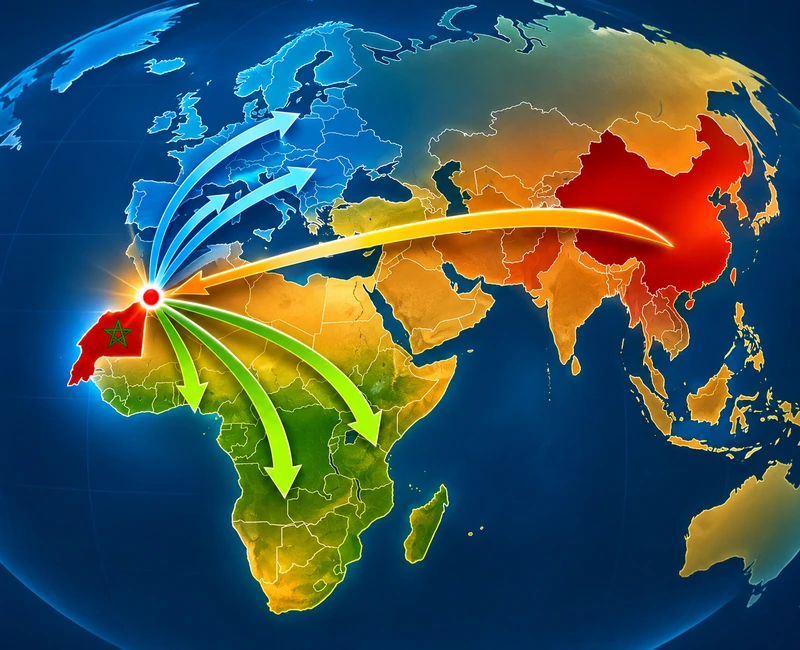
A European business may have a profitable order book but struggle to produce every operation at a cost its customers will accept. It may keep product design, certification, sales, engineering and final market responsibility in Europe while transferring selected manufacturing operations to a controlled facility in Southern Morocco.
This arrangement can range from an independent Moroccan subcontractor to a wholly owned subsidiary or an industrial joint venture. European components, Moroccan inputs or internationally sourced materials can arrive in Agadir; trained local teams transform them into assemblies or finished goods, and those goods return to their EU customers. Contracts determine ownership, warranties, technical data, transfer prices and the allocation of customs responsibilities.
The commercial argument is not theoretical. The European Commission reports bilateral EU–Morocco goods trade of €62.2 billion in 2025, including €25.5 billion of EU imports from Morocco. Machinery and transport equipment lead those import flows. These figures demonstrate an established trading relationship; they do not prove that any proposed factory in Agadir has demand or attractive margins. [1]
European clients own specifications, forecasting, end-market certification and sales relationships.
Identify repeatable stages with material conversion work and controllable quality requirements.
Develop local skills, disciplined production systems, inspection and, where suitable, solar power.
Deliver with traceable documentation, predictable lead times and an EU importer responsible for compliance.
Good initial prospects are small and mid-sized industrial businesses with recurring production batches, standardised quality requirements and no immediate need for just-in-time delivery within hours. Particularly relevant are companies whose machines or skilled workers spend excessive time on cutting, assembly, wiring, sewing, fitting, inspection or other conversion tasks that a trained production unit could perform elsewhere. Companies with frequently changing engineering drawings can still qualify—but only when communication, revision control and sample approval are unusually strong.
For highly automated plants, the wage advantage may be too small to cover new logistics and management. For extremely bulky, low-value goods, additional shipping may destroy the savings. Medical devices, aviation components and critical safety systems may require extensive approval before shifting production. These are strategic screening considerations rather than a claim that the industries cannot be served.
Agadir should not advertise a generic ability to manufacture everything. Each candidate below combines an identifiable European buyer need with operations that could be tested in a small production cell. Actual demand, engineering complexity and savings remain to be established with buyers.
European clients provide diagrams, tested components and acceptance criteria; Agadir cuts, crimps, labels, routes, assembles and tests. Suitable applications may include control cabinets, industrial equipment and non-safety-critical wiring.
Go/no-go: continuity testing, traceability, qualified operators, relevant electrical standards, approved tooling and warranty allocation.
Laser cutting, bending, welding, deburring and powder coating may be transferred in stages. European engineers retain drawings and dimensional tolerances; Moroccan operators add fabrication capacity.
Go/no-go: metal purchasing price, coatings, welding qualification, freight per kilogram and whether selected goods fall under EU CBAM. [18]
Flat-packed fittings, carcasses, machined panels and ready-to-install furniture components could be produced for European fit-out, hotel and residential suppliers. The strongest projects use standard modules and container-efficient packaging.
Go/no-go: moisture stability, surface finish, formaldehyde and material requirements, timber traceability and damage in transit.
Fabric cutting, stitching, finishing and packing can serve workwear, upholstery, covers and industrial textile brands that require documented quality and smaller replenishment lots.
Go/no-go: material origin, labour standards, customer audit requirements, pattern management and product-specific testing.
European mould owners could commission Agadir-based injection-moulding, finishing, insert fitting and assembly. This route becomes attractive when local equipment utilisation and product quality offset tooling, resin and transport costs.
Go/no-go: mould ownership, electricity load, scrap rates, resin cost, changeover frequency and maintenance skills.
Agadir can combine components into traceable industrial kits or modular subassemblies where substantive testing, fabrication or integration is part of the activity. A mere change of packaging must never be presented as manufacturing that creates preferential origin.
Go/no-go: unit economics, serial traceability, customs classification and the distinction between simple operations and origin-conferring processing. [6]
Before buying machinery, obtain three essential pieces of evidence: a signed sample specification, an indicative annual volume and a realistic target delivered price at the European receiving warehouse. Match these against at least two sourcing alternatives—continued EU production and another established manufacturing location such as Northern Morocco, Eastern Europe or the existing Asian supplier.
The right entry model depends on order certainty, the value of machinery, tolerance for execution risk and the European parent company’s ability to supervise an overseas operation.
A Moroccan supplier owns or operates the factory and sells manufacturing services or finished parts. Initial capital commitment may be low, but quality assurance, confidentiality and dependency on the supplier require close contractual control.
A European company invests in production equipment, hires staff and controls operations. It gains more process and IP control but accepts company administration, employment, management and capital risks.
A European buyer supplies volume, tooling or technology while a Moroccan partner contributes facilities, operating expertise and recruitment. Governance, ownership, transfer pricing and exit provisions become central.
A phased path is usually more robust: first prove the process in a supervised supplier cell, next reserve dedicated capacity, then evaluate a stand-alone plant when order commitments justify fixed investment. Moving every product at once creates too many variables—equipment, labour, customs, freight and customer certification—to diagnose failures efficiently.
A genuine nearshoring agreement should identify the owner of drawings, moulds and tooling; set an agreed bill of materials and revision-control process; define inspection protocols and acceptance criteria; allocate costs of scrap, recall and rework; stipulate traceability; address the right to audit; and clarify who acts as exporter and importer of record. Incoterms should be selected for the actual customs and transport roles, not copied from an old sales contract.
Nearshoring changes both production and customs. A European company that exports components to Morocco and imports finished goods must choose its procedures before the first truck leaves—not after the products are ready for delivery.
EU inputs are exported to Morocco, declared under the applicable Moroccan import procedure and processed. The completed product is then exported to Europe. The European importer checks classification, the customs value, origin, possible duties, import VAT and product conformity. An EU–Morocco trade agreement exists and industrial goods trade is liberalised, but preferential access still requires valid originating status and correct proof for the specific product. A Moroccan invoice does not establish origin. [1] [4] [5]
EU outward processing can be relevant when Union goods are exported temporarily for processing abroad and then re-imported. With the required customs authorisation, the re-import may receive relief calculated under the applicable rules, often focusing duties on processing value rather than treating the entire re-imported article as an ordinary new import. This is a separate customs mechanism from preferential origin: it does not automatically grant Moroccan origin, and it is not universally the best option. EU establishment, timing, accounting and identification conditions must be checked with the competent EU customs administration. [2] [3]
Outward processing concerns the customs treatment of temporarily exported Union goods that return after foreign processing. Preferential origin concerns whether the output meets the relevant agreement’s origin criteria. Depending on the input materials and industrial operations, neither, one or a different legal route may be applicable. Model each scenario on a product-level HS/CN basis before promising duty savings. [3] [4] [6]
Where suitable, Morocco’s inward-processing customs regimes may allow imported inputs to be processed and re-exported under defined controls, instead of being entered directly for ordinary domestic consumption. This can reduce the need to finance certain import duties and taxes, but requires authorised procedures, stock accounting, deadlines and proof of discharge. It must be arranged with Moroccan customs and the exporter’s logistics agent. [13] [14]
The EU–Morocco Association Council adopted an updated Protocol 4 on 2 October 2025. Origin treatment within the Pan-Euro-Mediterranean system is technical and has experienced transition rules. As a result, processing inside Morocco, the origin of imported inputs and the exact product-specific rule must be analysed together. Use the European Commission’s Access2Markets/ROSA for initial screening and obtain a professional or authoritative confirmation for material projects. Avoid assuming that a value added percentage applies to every product. [4] [5] [6]
A European brand or importer must still ensure that the product complies with relevant EU requirements. Depending on its classification, these may include technical legislation, CE conformity assessment, a technical file, material restrictions, declarations of conformity, appropriate labelling and traceability. The obligations must be assigned in the contract, with inspection records available when goods re-enter the EU. [16] [17]
For some iron, steel, aluminium and other specifically covered goods, the EU Carbon Border Adjustment Mechanism entered its definitive phase in 2026. Its application depends on exact CN codes and importer conditions; solar power in Morocco does not by itself remove CBAM obligations. Check the verified emissions data and relevant requirements at the beginning of a project. [18]
Check the outward-processing authorisation, declaration flow and re-import value.
Choose the correct temporary-admission or normal-import route for materials and machinery.
Approve tests, product standards, documentation and audit protocol.
Model duty, VAT timing, freight, currency exposure and working capital.
The region already promotes industrial ecosystems that include plastics, metalworking, construction materials, electricity and electronics, automotive and textiles. The Centre Régional d’Investissement (CRI) also lists established and proposed industrial locations. These are indications of regional development policy—not guarantees that a particular serviced plot is available. [11] [12]
The CRI lists an Industrial Acceleration Zone of 305 hectares and Haliopolis Park of 150 hectares in this prefecture. These may suit specific export-oriented or processing projects, subject to activity restrictions, zone entry terms and land availability. Eligibility for special zone tax/customs treatment must be confirmed, not inferred from the name. [11]
Industrial parks in the Aït Melloul area may suit component production, subcontracting and access to the labour pool. Published CRI information describes several industrial-park phases; the project should verify connection charges, congestion and actual plot availability. [11]
This prefecture is relevant when land supply, regional workforce recruitment or logistics make a peripheral location more efficient. A project must confirm whether the proposed site is permitted for its actual process and whether utilities can support the required industrial load. [7] [11]
Other Souss-Massa locations may offer industrial plots with different land costs and incentive categories, but may also increase road transport, recruitment or service requirements. Lower land cost is useful only when the overall operation remains competitive. [7] [11]
CRI Souss-Massa’s official Investment Charter explanation lists Inezgane–Aït Melloul, Chtouka–Aït Baha and Taroudant in territorial category A (10% under the main scheme) and Tiznit and Tata in category B (15%). Agadir Ida-Outanane is not listed among these category A/B prefectures. The eligible location, actual incentive and whether an industrial zone has special conditions require formal confirmation before acquiring land. The 30% combined incentive ceiling still applies. [7]
Agadir has advantages in the broader Souss-Massa workforce, access to Southern Moroccan markets, potential industrial land and solar resources. But a European company shipping to northern France or Germany must compare road-to-port time, frequency of maritime services, inventory days and haulage rates against Tangier, Kenitra, Casablanca and established European subcontractors. The proximity advantage is European–Moroccan coordination compared with distant overseas supply—not a claim that Agadir is Morocco’s closest industrial city to the EU.
Morocco’s Investment Charter creates distinct support mechanisms. The correct route depends on investment amount, stable Moroccan employment, ownership structure, industry, municipality and the project’s compliance with eligibility rules. Grants are generally governed by formal investment agreements; they cannot be treated as money already received. [8] [23]
The main mechanism may apply where an investment reaches MAD 50 million and creates at least 50 stable jobs, or where a project creates more than 150 stable jobs irrespective of investment size. Potential components include employment, sustainability, local integration, strategic sector and territorial premiums. A 30% maximum is a ceiling, not an entitlement. [7] [8]
Decree 2-25-342 sets a separate mechanism for qualifying Moroccan-law private companies. Baseline investment must be at least MAD 1m and below MAD 50m; generally at least 10% equity and 1.5 stable jobs per MAD 1m invested are required for non-tourism projects. Revenue, ownership, regional-sector and other tests also apply. [9] [10]
Under the published SME decree, the possible components are 5%, 7% or 10% for employment intensity (depending on new stable jobs relative to investment), 10% or 15% territorial support for eligible category A/B locations, and 10% for qualifying priority activities, with a combined ceiling of 30%. A stable job for this scheme is a new position lasting at least 18 consecutive months, held by a Moroccan worker registered with CNSS. Companies recently created can in certain circumstances be eligible without meeting the normal historical revenue requirement. [10]
SME status under the decree has further conditions: turnover below MAD 200m, limitations when a larger company owns more than 25% of the applicant, and exclusions involving public entities. A nearshoring subsidiary of a large European group must not assume it will be eligible just because its Moroccan factory is small. The group ownership and other criteria need specific review. [10]
Eligible expenditure is not the same as total planned spending. The SME decree excludes vehicles and certain related-party transactions; imposes limits on studies, branding, processes and qualifying private land; and sets procedures for documentation and staged payments. Funding is paid against evidence and the project’s commitments. An application should therefore precede irrevocable spending where required, and the financial plan should work without a modelled grant. [10]
Assume a qualifying SME has MAD 10 million of eligible investment, satisfies the necessary ownership, job, location and sector requirements, and is awarded a modelled combined 20% premium. The potential grant would be MAD 2 million, subject to approval and milestone conditions. If just one eligibility condition fails, the outcome may be a smaller grant or no grant at all. The example is not a forecast or an official approval.
Agadir receives approximately 300 days of sunshine per year, according to Morocco’s National Tourist Office; CRI Souss-Massa also highlights the region’s solar resource. For a daytime manufacturing plant with a suitable roof or plot, solar photovoltaic generation can reduce grid-electricity purchases and exposure to future tariff increases. [19] [12]
Sunny days are not a guarantee of a particular photovoltaic output. Real generation depends on irradiation, panel orientation, shadows, temperatures, losses, dirt accumulation and equipment performance. Equally important is when electricity is consumed. A factory operating presses, cutters, air compressors or machinery during daylight hours can often consume a meaningful share of its solar production on site. A plant that works mainly at night may require a different design or storage economics.
| Assumption / calculation | modelled value |
|---|---|
| PV installed capacity | 200 kWp |
| Assumed annual specific generation | 1,500 kWh/kWp |
| Estimated yearly PV output | 300,000 kWh |
| Share used directly by factory | 80% |
| Grid electricity avoided | 240,000 kWh |
| Assumed avoided variable electricity cost | MAD 1.10/kWh |
| modelled gross annual avoided purchases | MAD 264,000 |
All production, consumption and tariff inputs above are modelled assumptions, not measured local figures or a supplier offer. They exclude PV capital cost, funding, insurance, maintenance, inverter replacement, degradation, grid charges and taxes. The MAD 264,000 figure represents modelled gross avoided electricity purchases. A site-specific solar estimate should be produced with the European Commission’s PVGIS tool and compared with real interval-meter data and a written electricity tariff. [22]
Morocco’s Law 82-21 covers electricity self-generation. Its implementing framework includes Decree 2-25-100, published in March 2026. The design and approval route depend on whether a system is connected to the grid, the size of the facility and the network voltage. Before purchasing panels, the investor should check grid-connection permission, network constraints, export limits, metering and commercial conditions with the relevant network operator and regulator. [20]
Excess solar electricity should not be valued at the ordinary retail tariff. ANRE has published MAD 0.18/kWh off-peak and MAD 0.21/kWh peak for the first 2026–2027 regulatory period for eligible surplus electricity on the networks in scope; low-voltage treatment has separate regulatory considerations. The strongest business case may therefore be to size PV for direct daytime self-consumption rather than speculative export revenue. [21]
Solar electricity may also support environmental performance reporting requested by European customers. However, a PV installation does not automatically qualify the factory for a sustainability grant, make every product carbon-neutral or establish compliance with EU CBAM. Each claim requires its own supporting evidence. [18] [20]
Investors frequently compare hourly wages, conclude that Morocco is cheaper and stop there. This misses actual productivity, the cost of raw materials, supervision, training, freight, customs, rework and the extra cash tied up in inventory. A sound model compares the full delivered cost per accepted unit at the same technical specification and delivery reliability.
| Cost component | EU factory | Agadir |
|---|---|---|
| Materials and purchased parts | €7.50 | €7.50 |
| Productive direct labour | €6.00 | €2.90 |
| Factory operating overhead | €2.60 | €2.40 |
| Engineering, inspection and quality | €1.00 | €1.25 |
| Delivered freight and border handling | €0.40 | €1.50 |
| Scrap and rework allowance | €0.45 | €0.55 |
| Inventory financing and administration | €0.45 | €0.70 |
| modelled total delivered cost | €18.40 | €16.80 |
Operating scenario: a repeat-order assembly produced to an identical specification, assumed to qualify for the illustrated border costs. No product-specific EU import duty is included, and VAT cash-flow, machinery investment, setup, warranty reserves, solar capital cost and grants are not fully modelled. These values are not statements of prevailing EU or Moroccan labour rates, transport quotes or probable factory margins.
The example yields a potential €1.60 reduction per unit (about 8.7%). At 50,000 accepted units annually, this would equal €80,000 in annual operating-cost difference before one-off relocation expenditure and unmodelled costs. If freight rises by €0.80 per unit, or productivity falls enough to increase labour cost by €0.80, the estimated advantage disappears. This is why a measured pilot is more useful than any brochure percentage.
Conversion labour: for tasks with meaningful manual work and repeatable training.
Industrial growth: additional production capacity without expanding expensive existing European premises.
Solar self-consumption: lower grid purchases where daytime factory consumption matches output.
Investment assistance: approved grants can reduce eligible capital expenditure, but only if awarded and paid.
Lower initial productivity: training time, process maturity and reject rates.
Logistics and customs: an extra border crossing, documentation and stock days.
Quality exposure: product returns, customer audits and urgent rework trips.
Fixed investment: duplicating machines, power infrastructure, management and tool maintenance.
Prepare three cases: a base case with signed demand; a downside case with 20% lower production volume, one month of delivery disruption and higher defect rates; and a scale-up case with a second production shift. Compare EBITDA, operating cash flow, working capital peak, debt-service coverage and payback before and after any approved subsidy. Include EUR/MAD exchange exposure and the timetable between paying suppliers and receiving customer invoices.
Successful nearshoring depends on a local general manager, supervisors who understand production discipline, technicians who can maintain equipment and an inspection team with authority to stop nonconforming goods. Recruitment plans should distinguish operators from technical roles; the latter may require more training or temporary support from the European parent. Regional education and training resources can be discussed with CRI Souss-Massa, but the actual talent pool for each trade needs a labour-market survey. [11] [12]
Industrial workforce budgeting must include applicable wages, employer contributions, shift arrangements, paid leave, insurance and lawful working conditions. A European investor also needs a documented approach to workplace safety, wages, working hours, grievance handling and supplier audits. The main investment grants reward stable, registered jobs under defined tests; an employment figure in a business plan is not itself evidence that the jobs have been created. [10]
Cycle-time and scrap reporting, preventive maintenance, planned capacity and documented corrective actions.
Incoming checks, first-article approval, calibrated equipment, final acceptance and batch traceability.
Skills matrix, safe work instructions, supervisor development and verified employer obligations.
Change control, audits, quality agreements, agreed KPIs and an escalation contact in Europe.
Recommended operational metrics include delivered-on-time-in-full (OTIF), first-pass yield, defects per million or per batch, material loss, energy consumed per accepted unit, rework hours, inventory days and customer claims. These should be measured during a pilot rather than advertised as guaranteed future performance.
Existing commercial framework: established EU–Morocco industrial trade and an investment infrastructure. [1]
Regional production ecosystem: technical industries, industrial land and a developing labour base. [11] [12]
Solar opportunity: approximately 300 sunny days annually, with the potential for real daytime electricity cost reductions. [19]
Multiple operating models: contract manufacturing, own plant or joint venture, staged as demand becomes real.
Delivery geography: some European destinations will be served more cheaply from Northern Morocco or an EU factory.
Incomplete customs assumptions: outward processing and origin preferences do not automatically apply. [2] [4]
Grant eligibility: large-company ownership or the wrong prefecture can eliminate expected support. [7] [10]
Execution: weak quality systems, poor machine uptime or excessive lead times can outweigh any labour saving.
Tangier / Kenitra: potentially stronger for northern European freight and established automotive networks; Agadir needs to win on project-specific land, manpower, solar and supplier strategy. Casablanca: a broad service and industrial ecosystem, but very different site costs and operating constraints. Eastern Europe: no extra EU customs frontier, although local wages and site availability may differ. Asia: long-established sourcing capacity may remain cheaper for certain high-volume products, despite longer supply chains. The correct winner cannot be chosen without freight quotes, labour productivity data and actual facility offers.
Nearshoring can reduce some transport distances compared with distant suppliers, but it does not automatically lower total emissions. Transport mode, recycled content, production efficiency, energy mix and material choice matter. If a customer wants a carbon comparison, commission a product-specific footprint and separate measured solar electricity from unverified marketing estimates.
Secure a product drawing, target order size, forecast, acceptance criteria and existing total cost at the European receiving warehouse. Filter out products with poor volume-to-value ratios.
Confirm materials, origin and HS/CN codes. Decide which EU outward-processing and Moroccan inward-processing options may be available; determine EU product and importer requirements. [2] [5] [13]
Obtain plot or building offers for specific Agadir-area industrial locations, a utility-capacity letter, recruitment market evidence, freight proposals and a PVGIS estimate. Verify the exact prefecture and incentive classification. [7] [11] [22]
Produce a limited quantity with recorded cycle times, defect rates, transport experience and energy use. Obtain formal sample approval from the European client and revise the economic model.
Choose the contract, subsidiary or joint-venture structure; register where required with OMPIC; prepare the CRI investment file, equity evidence, new-jobs plan and permitting documents before assuming grants. [10] [15] [24]
Move to a dedicated production line only when operating performance and customer volumes justify it. Add photovoltaic generation after interval-meter analysis and grid-connection review, not simply because the climate is sunny. [20]
That case is convincing only with accepted customer samples, a defensible delivered-cost comparison, verified customs treatment, a realistic staffing plan, site-specific energy assumptions and support confirmed by the competent authorities.
Official sources are referenced near the claims they support. Material marked “modelled” is a modelling assumption rather than a verified market quotation. The details of a specific investor, product, employer, factory address and destination country can materially change customs treatment, grant eligibility, tax obligations and power economics.