
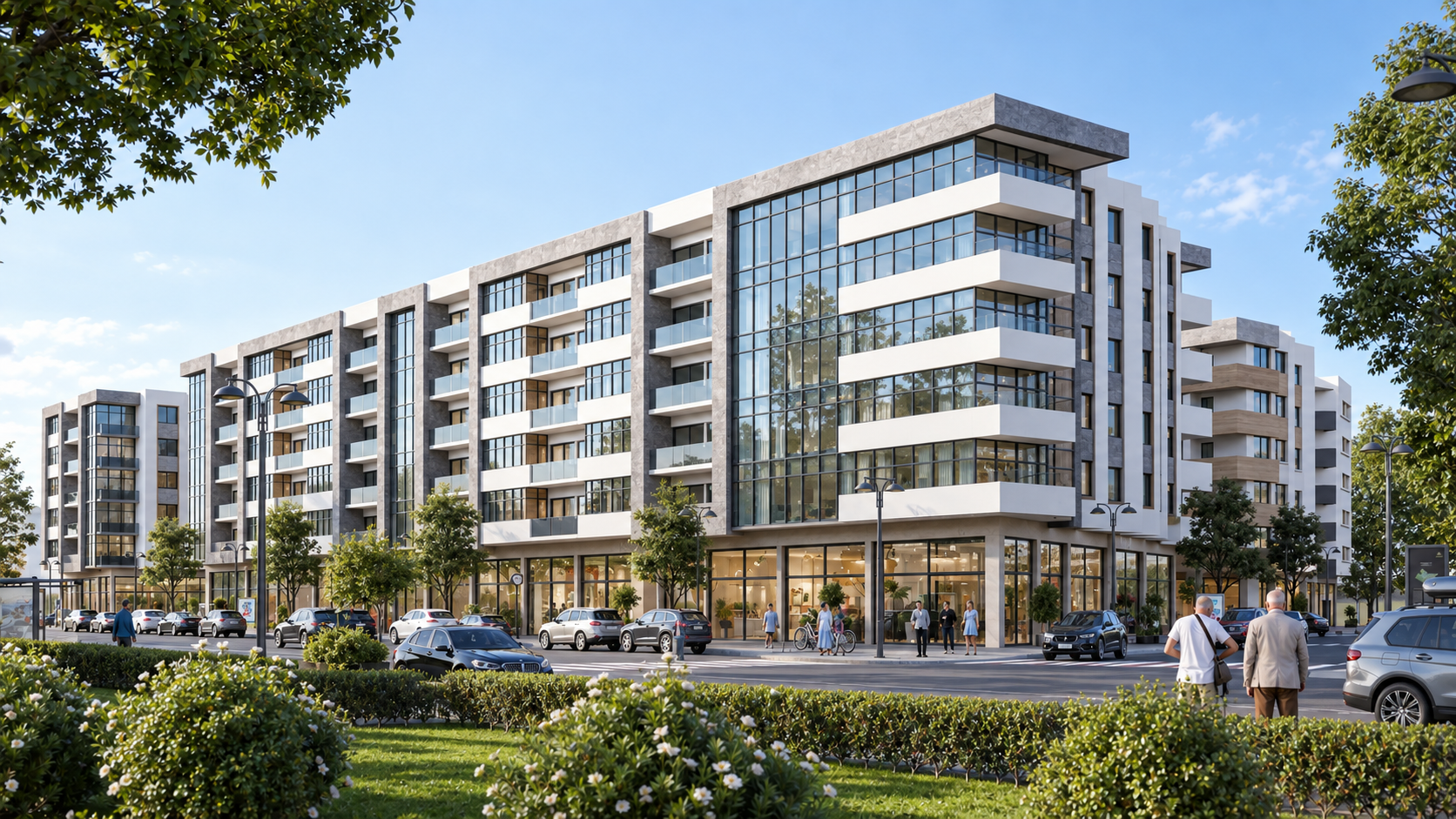
Why invest in property in Agadir?
Agadir is one of the few coastal cities in North Africa where a buyer can still acquire a well-built apartment within walking distance of a wide Atlantic beach, in a city with a functioning international airport, a university, a working port and a year-round tourist base — without paying the prices commanded by Marrakech, Casablanca or Tangier. That combination, rather than any single factor, is what makes the city worth a serious look.
This article sets out the case honestly. It covers what actually drives demand in Agadir, what the city offers that competing Moroccan markets do not, where the risks sit, and how a foreign buyer should think about the decision. It is written for someone considering a real purchase, not for someone browsing.
What Agadir actually is, economically
Agadir is the capital of the Souss-Massa region and the largest city in southern Morocco, with a metropolitan population in the region of half a million people. It is not a resort town bolted onto a fishing village. It is a working regional capital with a diversified economy: agriculture and agri-food processing in the Souss plain, commercial fishing and fish processing at the port, tourism along the bay, a growing services sector, and a university that produces a steady stream of graduates who need housing.
That matters for property investors because it means demand is not purely seasonal. A city that depends only on tourism empties in the low season and rental income collapses with it. Agadir has a resident population that needs somewhere to live twelve months a year, alongside a tourist population that needs somewhere to stay for part of it. The two demand streams are different in character and they do not peak at the same time.
Why the climate and geography matter more than people admit
Agadir sits on the Atlantic, sheltered by the High Atlas to the north and east. The result is a climate that is mild in winter and moderated in summer by the Canary Current — the coastal water is cool, the sea breeze is reliable, and the city avoids the extreme inland heat of Marrakech. For northern European buyers in particular, this is the single most underrated factor. A property that is comfortable in February and bearable in August supports both winter letting and summer letting, which widens the rental calendar considerably.
The bay itself is roughly ten kilometres of sandy beach, unusually wide and unusually accessible. The promenade has been progressively upgraded, and the beach is a genuine public asset rather than a private hotel strip. Properties within reasonable walking distance of it command a premium, and that premium has held.
The airport is the hinge
Al Massira Airport lies about 25 kilometres east of the city and handles several million passengers a year, with direct flights to a long list of European cities including Paris, London, Amsterdam, Brussels, Frankfurt, Manchester and Dublin, plus domestic links to Casablanca and other Moroccan cities. Flight times from most of Western Europe are in the three-to-four-hour range.
This is not a trivial detail. Short-term rental performance in any coastal city is driven by accessibility. A destination that requires a connection or a long transfer will attract fewer weekend and short-break visitors, and those are the bookings that fill the gaps between longer stays. Agadir's direct European network means a buyer can realistically expect a functioning holiday-let market rather than a theoretical one.
Tourism, and what it actually means for property
Agadir receives a substantial volume of visitors annually, and the tourism base is broader than the beach. The city is a established golf destination with several courses in and around the city, a recognised surfing base with the Taghazout and Tamraght breaks a short drive north, a winter-sun destination for European retirees, and a domestic tourism destination for Moroccans from inland cities.
For a property investor, the practical implication is that demand is segmented. Golfers want proximity to courses and quiet. Surfers want the northern coast. Families want the beach and the promenade. Domestic tourists want value and access to the city centre. A single apartment cannot serve all of them, but it can serve one of them well, and understanding which segment a given property targets is more useful than looking at citywide average occupancy figures.
The development trajectory of the city
Agadir is expanding. Municipal planning documents outline continued expansion of the Greater Agadir metropolitan area through 2035, with new residential districts, upgraded road infrastructure, and public investment aimed at shifting the city from a seasonal resort economy toward a year-round regional metropolis.
Specific projects worth knowing about include the ongoing development of the Agadir Marina and the surrounding Founty district, the Taghazout Bay resort development to the north, road and transport upgrades intended to improve connections between the city centre and the emerging eastern and southern districts, and public investment in the city's waterfront and public spaces. Each of these affects different micro-markets differently. Buyers should verify the current status of any project they are relying on, because announcements in Morocco, as anywhere, do not always translate into completed infrastructure on the timetable originally stated.
What the price level looks like relative to alternatives
Agadir is not the cheapest property market in Morocco and it is not the most expensive. Broadly, it sits below Marrakech and Casablanca for comparable quality in central locations, and roughly in line with or slightly above Tangier depending on the district. Compared with European coastal markets — the Algarve, the Costa del Sol, Cyprus, Crete — the entry point is materially lower for a comparable coastal apartment.
The more useful comparison is within Morocco. Marrakech offers a stronger international brand and a deeper luxury market, but the pricing reflects that and the city's property market is more exposed to the high-end segment. Casablanca is an economic capital with strong rental demand but prices to match, and it is not a holiday market. Tangier benefits from proximity to Spain and the Tanger Med port, but its property market has already priced in much of that story. Agadir's case is that it combines a real coastal lifestyle with a working regional economy at a price point that still leaves room for realistic rental yields.
Rental income: what is realistic
Gross rental yields on well-chosen apartments in Agadir typically fall in a range that is attractive by Western European standards, though the range is wide and depends heavily on district, property type, furnishing standard and letting strategy. Long-term letting to residents produces lower headline yields but far more predictable occupancy and lower operating costs. Short-term holiday letting produces higher gross income in peak periods but with seasonal swings, higher management costs, and greater sensitivity to competition from new supply.
Any investor should model both scenarios before committing, and should be sceptical of projections that assume peak-season occupancy year-round. A realistic model assumes some vacancy, some maintenance, some management cost, and a gap between gross and net yield. The difference between a plausible forecast and a promotional one is usually in those assumptions.
Foreign ownership: the legal position
Foreign nationals can legally purchase property in Morocco, including in Agadir. There are no restrictions on foreign ownership of apartments or built residential property, and the purchase process is well established. Freehold title is registered through the Moroccan land registry (Conservation Foncière), and purchases are typically completed before a notary.
The process is not identical to a European purchase and requires proper diligence: verifying title, checking that the property is properly registered, confirming there are no outstanding charges or disputes, and ensuring funds are transferred through official channels with the correct documentation for eventual repatriation of sale proceeds. Buyers who skip these steps, or who rely solely on the seller's assurances, create problems for themselves later. The process itself is manageable with the right local support, but it is not a formality.
What can go wrong
The honest risks are these. First, liquidity: Agadir is a smaller market than Marrakech or Casablanca, and resale can take longer than a seller expects, particularly at the higher end or in less established districts. Second, construction and developer risk: off-plan purchases carry the usual risks of any off-plan market, and the quality of developers varies. Third, currency: the dirham is managed within a band against a basket of currencies, and exchange-rate movements affect both the euro or sterling cost of a purchase and the value of rental income repatriated. Fourth, regulatory and tax complexity for non-residents, which requires proper advice. Fifth, the simple risk that a buyer pays too much because they compared the price to their home market rather than to the local market.
None of these are reasons to avoid the market. They are reasons to enter it with proper diligence, a realistic model, and local advice rather than enthusiasm alone.
The case in summary
Agadir offers a combination that is genuinely difficult to find elsewhere at the price: a mild coastal climate, a wide and accessible beach, direct European flights, a diversified regional economy, a resident population that supports year-round rental demand, and a legal framework that permits foreign ownership. It is not Marrakech and should not be assessed as though it were. It is a working coastal city with a growing property market, and for an investor seeking a coastal asset with a real rental market rather than a trophy address, it deserves serious consideration.
The right approach is disciplined: define the strategy first (income, capital growth, personal use, or a mix), choose the district to match that strategy, verify everything, model the numbers conservatively, and buy well rather than quickly.
Investment opportunities with Agadir Investment
Agadir Investment works with international buyers seeking exposure to the Agadir property market and the wider Souss region. There are two principal routes.
1. Property investment
Investors can purchase property in Agadir across a range of types: apartments, new-build residences, villas, holiday homes, buy-to-let properties and long-term holdings. Agadir Investment also provides property management services, so owners who do not live in Morocco can have their property managed on their behalf — covering day-to-day operations, guest or tenant handling, and maintenance coordination — without needing to be present.
2. Investment in property development
For larger investors, there is the option to invest directly in the financing and development of property projects. For investments from €5,000,000, Agadir Investment states a fixed, guaranteed return of 7% per year. This is not an estimated or variable return but the stated fixed rate, subject to the applicable contractual terms. Investors considering this route should review those terms carefully with their own advisers before committing.
Contact
To discuss either route, or to request current availability and documentation, contact Agadir Investment at agadirinvestment.com or by email at info@agadirinvestment.com.