
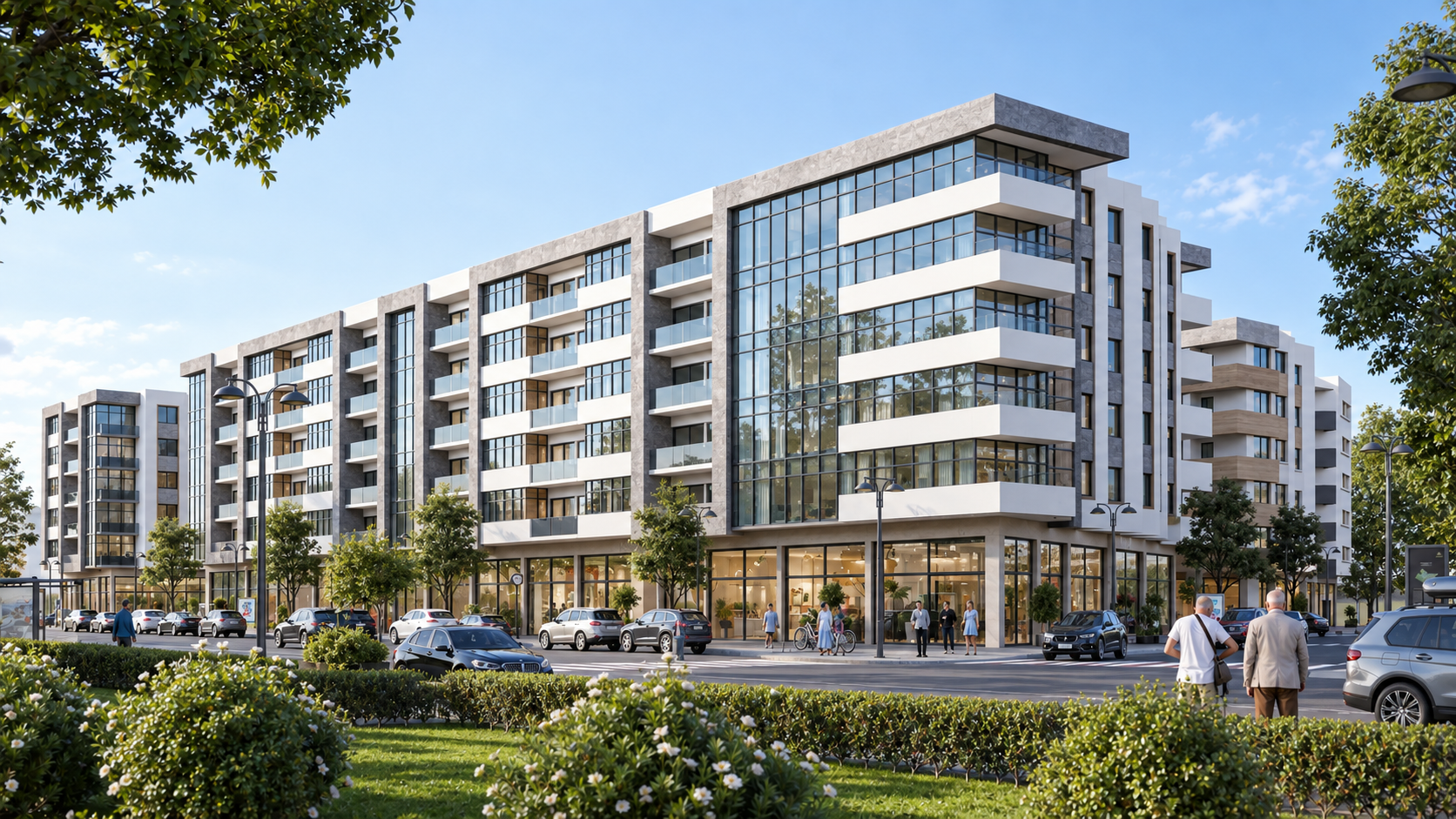
What makes Agadir attractive to overseas property buyers?
Agadir does not compete with Marrakech for the luxury buyer, and it does not compete with Casablanca for the business traveller. What it offers is something narrower and, for a specific type of overseas buyer, more useful: a coastal city with a working economy, a mild Atlantic climate, direct European flights, and property prices that still leave room for a realistic return.
This article examines the factors that actually draw international buyers to Agadir, using current data rather than general impressions. It also considers what those buyers should be cautious about, because an honest assessment is more useful than a sales pitch.
The climate and the coast
The most immediate attraction is environmental. Agadir sits on the Atlantic, sheltered by the High Atlas, with a climate moderated by the Canary Current. Winters are mild, summers are bearable, and the coastal breeze is reliable. For northern European buyers in particular, this is a meaningful difference from the inland heat of Marrakech or the humidity of more tropical destinations.
The beach itself is unusually wide and public, running for roughly ten kilometres along the bay. The promenade has been progressively upgraded, and the beach functions as a genuine public asset rather than a private hotel strip. Properties within walking distance of it command a premium, and that premium has held across market cycles.
Airport connectivity that actually works
Al Massira Airport handled 3,495,277 passengers in 2025, an increase of 11.07% over 2024 . It is the third busiest airport in Morocco, after Casablanca and Marrakech . Direct flights connect Agadir to a long list of European cities, with flight times from most of Western Europe in the three-to-four-hour range.
This matters for property investors because short-term rental performance depends on accessibility. A destination that requires a connection or a long transfer attracts fewer weekend and short-break visitors, and those are the bookings that fill the gaps between longer stays. Agadir's direct European network makes a functioning holiday-let market realistic rather than theoretical.
Tourism demand with real numbers behind it
Agadir recorded approximately 7.5 million overnight stays in the first eleven months of 2025, an increase of 11% . The city and the surrounding Taghazout area welcomed over 1.5 million tourists in 2025, a 9% increase over 2024, with occupancy rates in classified accommodation exceeding 66% .
These are not speculative figures. They reflect a tourism base that is broader than the beach. Agadir is an established golf destination, a recognised surfing base with the Taghazout and Tamraght breaks a short drive north, a winter-sun destination for European retirees, and a domestic tourism destination for Moroccans from inland cities.
For a property investor, the practical implication is that demand is segmented. Golfers want proximity to courses and quiet. Surfers want the northern coast. Families want the beach and the promenade. Domestic tourists want value and access to the city centre. A single apartment cannot serve all of them, but it can serve one of them well.
Price levels that leave room for returns
Agadir apartment prices typically range from MAD 12,000 to MAD 25,000 per square metre depending on district and quality, with premium seafront locations at the top of that range and more affordable central districts such as Talborjt at MAD 8,000 to MAD 12,000 . Emerging areas to the north, including Aourir and Tamraght, start lower, at around MAD 6,000 to MAD 10,000 per square metre .
Gross rental yields vary by strategy. Long-term residential letting in established districts typically produces yields in the mid-single digits, while short-term holiday letting in tourist-relevant locations can reach the high single digits or low double digits for well-run properties . The city has experienced annual price increases of 8% to 12% in sought-after areas since 2023, though these figures are indicative rather than guaranteed .
The comparison with European coastal markets is the one most buyers make. Compared with the Algarve, the Costa del Sol, Cyprus or Crete, the entry point for a comparable coastal apartment is materially lower. That lower entry price translates into a lower absolute capital requirement and, for a given rental income, a potentially higher cash-on-cash return.
A working economy, not just a resort
Agadir is the capital of the Souss-Massa region and the largest city in southern Morocco, with a metropolitan population in the region of half a million. It is not a resort town bolted onto a fishing village. It has a diversified economy: agriculture and agri-food processing in the Souss plain, commercial fishing and fish processing at the port, tourism along the bay, a growing services sector, and a university that produces a steady stream of graduates who need housing.
That matters for property investors because it means demand is not purely seasonal. A city that depends only on tourism empties in the low season and rental income collapses with it. Agadir has a resident population that needs somewhere to live twelve months a year, alongside a tourist population that needs somewhere to stay for part of it. The two demand streams are different in character and they do not peak at the same time.
Foreign ownership is straightforward
Foreign nationals can legally purchase residential property in Morocco, including in Agadir. There are no restrictions on foreign ownership of apartments, villas or built residential property. Freehold title is registered through the Moroccan land registry, and purchases are completed before a notary.
The process requires proper diligence: verifying title, checking that the property is properly registered, confirming there are no outstanding charges, and ensuring funds are transferred through official channels. A convertible dirham account is required, and funds must enter through the banking system to preserve the right to repatriate proceeds later. None of this is prohibitively difficult, but it is not a formality either.
The development trajectory
Agadir is expanding, and that expansion is part of the investment case. Municipal planning for Temsia, one of the communes within Greater Agadir, provides for a development area of around 62 km² with capacity for a future population of 76,585 by 2035 . The Souss-Massa 2026–2030 infrastructure plan includes investment in the Agadir–Marrakech highway, expansion of Agadir port, and the Aourir-Taghazout tourist zone .
Taghazout Bay has become the most dynamic submarket, with prices rising from MAD 7,000 to MAD 15,000 per square metre following the arrival of international hotel brands and a wealthy international clientele drawn by surf and golf .
For investors, the practical point is that growth is real but uneven. Infrastructure that is announced is not the same as infrastructure that is built, and the timeline for any specific project should be verified before it is relied upon. Buyers who treat planning documents as guarantees tend to be disappointed.
What overseas buyers should be cautious about
Liquidity. Agadir is a smaller market than Marrakech or Casablanca. Resale can take longer than sellers expect, particularly at the higher end or in emerging districts.
Seasonality. The high season from June to September can represent around 60% of annual rental income for holiday lets . Investors who model peak occupancy year-round will be disappointed.
New-build competition. Active residential development across the city means an investor holding an apartment in a district with several competing new projects may face rental and resale competition from newer stock.
Currency exposure. The dirham is managed within a band. Exchange-rate movements affect both the cost of a purchase and the value of repatriated rental income.
Title and planning verification. Not all land in the wider agglomeration is registered. Some peripheral plots remain under melkiya status, and buyers should avoid unregistered land entirely .
Who Agadir actually suits
Agadir suits the overseas buyer who wants a coastal property with a genuine rental market, a reasonable entry price, direct European flights, and a city that functions outside the tourist season. It suits the buyer who intends to use the property personally for part of the year and let it for the rest. It suits the investor who is prepared to define a strategy, choose a district to match it, verify everything, and model the numbers conservatively.
It does not suit the buyer seeking rapid capital appreciation, deep liquidity, or a trophy address with instant international brand recognition. It is not Marrakech, and it should not be assessed as though it were.
The attraction of Agadir is not that it is the best property market in Morocco. It is that it offers a specific combination — climate, coast, connectivity, economy, and price — that is genuinely difficult to find elsewhere at the same level. For the right buyer, that combination is compelling.
Investment opportunities with Agadir Investment
Agadir Investment works with international buyers seeking exposure to the Agadir property market and the wider Souss region. There are two principal routes.
1. Property investment
Investors can purchase property in Agadir across a range of types: apartments, new-build residences, villas, holiday homes, buy-to-let properties and long-term holdings. Agadir Investment also provides property management services, so owners who do not live in Morocco can have their property managed on their behalf — covering day-to-day operations, guest or tenant handling, and maintenance coordination — without needing to be present.
2. Investment in property development
For larger investors, there is the option to invest directly in the financing and development of property projects. For investments from €5,000,000, Agadir Investment states a fixed, guaranteed return of 7% per year. This is not an estimated or variable return but the stated fixed rate, subject to the applicable contractual terms. Investors considering this route should review those terms carefully with their own advisers before committing.
Contact
To discuss either route, or to request current availability and documentation, contact Agadir Investment at agadirinvestment.com or by email at info@agadirinvestment.com.