
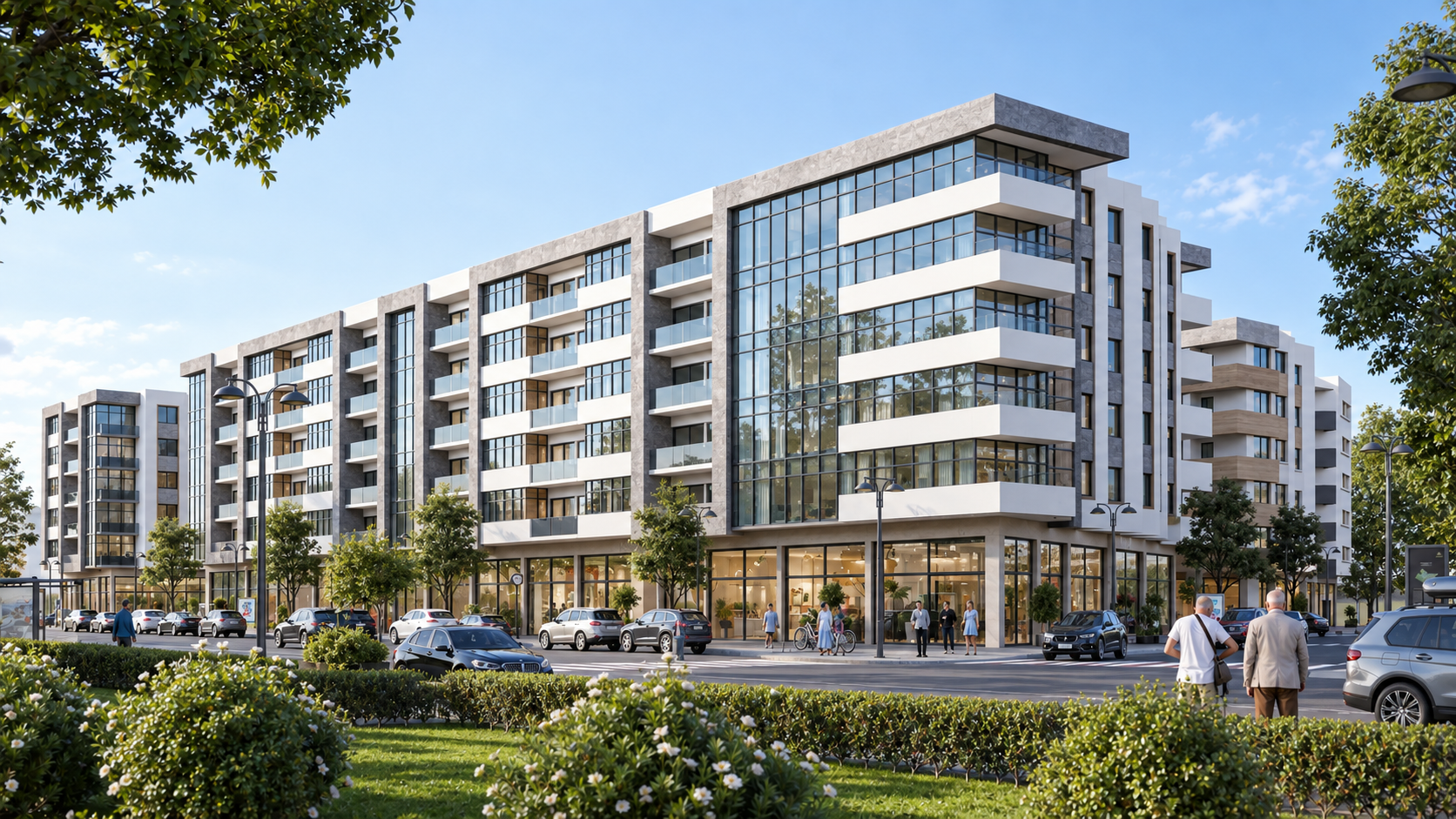
Is Agadir growing as a destination for property buyers?
The question can be answered from several angles, and they all point in the same direction. The city is receiving more visitors, the airport is handling more passengers, the hotel sector is running near capacity, and the infrastructure is being expanded to accommodate the growth. Those factors do not automatically make Agadir a better place to buy property, but they create the conditions in which demand for accommodation, and therefore for property, is likely to remain strong.
This article examines the evidence on Agadir's growth as a property destination, the data that supports it, and the limits that a buyer should understand.
The tourism data: more visitors, higher occupancy
The most immediate indicator is the tourism performance. Agadir recorded a hotel occupancy rate of 86% at the end of August 2026, the highest among Moroccan destinations, against a national average of 61%. The revenue per available room (RevPAR) rose by 14% over the same period, reaching 1,156 MAD, above the national average of 1,093 MAD .
The overnight stays tell the same story. The city recorded 4.97 million overnight stays in the first seven months of 2026, an increase of 11% over the previous year, maintaining its position as the second national destination with around 19% of the total . Arrivals reached 1.06 million in the first eight months, an increase of 4.59%, with the British, domestic, French and Polish markets driving the growth .
The practical implication is that Agadir is not a marginal destination. It is one of the strongest performers in the Moroccan tourism market, and the demand is broad enough to support a range of accommodation types, from hotels to short-let apartments.
The airport data: more passengers, more connectivity
The airport is the gateway, and the numbers reflect the growth. Agadir Al Massira Airport received approximately 2.5 million passengers in the first eight months of 2026, an increase of 8.74% over the same period in 2025. International flights accounted for the largest share, with 2.1 million passengers, up 9.62% .
The airport is also being expanded. The project, with a budget of 1.8 billion MAD, aims to increase the annual capacity from 2.6 million to 7 million passengers, through a new 75,000 m² terminal and four additional aircraft stands. The African Development Bank's financing for the Airport Infrastructure Expansion and Modernisation Programme supports a target of five million passengers at Agadir by 2030 .
The practical implication is that the growth in visitor numbers is supported by the infrastructure that brings them. The airport expansion is not a speculative project; it is a response to the demand that already exists, and it will make it easier for more visitors to reach the city.
The supply constraint: a hotel sector near saturation
The growth in demand has not been matched by a corresponding growth in hotel capacity. The In Extenso barometer notes that Agadir's hotel sector is "very close to saturation," with a significant share of the classified accommodation out of service: 19 establishments, representing 6,524 beds, are closed, under renovation, or for sale .
The mid-range segment is particularly tight, with an occupancy rate of 91% in the first eight months. Gregory Fortems, the author of the barometer, notes that this shows a clear lack of mid-range and premium economy hotels capable of meeting the demand from families .
The practical implication is that the accommodation demand is not fully met by the hotel sector. That gap is filled by the short-let market, which is the segment that a property buyer can access. The saturation of the hotels is, in effect, an opportunity for the private rental market.
The property market data: prices and transactions
The property market data is more mixed. Global Property Guide puts the average asking price for an Agadir apartment at $747 per square metre in the first quarter of 2026, with a slight quarterly decline of 0.8% and a two-year decline of 2.5% . That is not a market in rapid appreciation. It is a market that has been broadly stable to modestly negative at the citywide level.
Aqarrati's 2026 guide is more optimistic, noting that Agadir has experienced a "remarkable catch-up dynamic since 2023," with annual price increases of 8% to 12% in sought-after areas, driven by the Taghazout Bay development and the Souss-Massa infrastructure plan . The difference between the two sources reflects different samples, different periods, and different definitions of the market.
La Vie Éco reports that transactions are picking up in Agadir, with sustained demand, constrained supply, and increasingly rare land. The prices are evolving in a very differentiated way depending on the segment and the district .
The practical implication is that the market is not uniform. The citywide averages suggest stability, but the district-level data suggests that specific areas, particularly those benefiting from the tourism and infrastructure investment, are performing better than the average.
The limits: housing pressure and local affordability
The growth of Agadir as a property destination has a social dimension that a buyer should understand. The pressure on the housing market has made it difficult for local residents to find affordable accommodation. A report in Al Jarida 24 describes a "housing crisis" in Agadir, with families struggling to find apartments, and some properties kept empty for months to be rented at peak-season prices to tourists .
The same report notes that apartments that were selling for 250,000 MAD in Hay Salam are now selling for 500,000 MAD or more, and that projects under construction are sold off-plan before completion, leaving little room for buyers with limited budgets .
The practical implication is that the growth of the market is not without tension. A buyer who purchases for short-term letting is participating in a market that is also the subject of local concern about affordability. That does not make the investment illegitimate, but it is a context that a responsible buyer should be aware of.
The Agadir context
Agadir is expanding, and the expansion is supported by a broad infrastructure programme. The municipal planning for Temsia provides for a development area of around 62 km² with capacity for a future population of 76,585 by 2035. The Souss-Massa 2026–2030 plan includes investment in the Agadir–Marrakech highway, the expansion of Agadir port, and the Aourir-Taghazout tourist zone .
For a property buyer, the practical implication is that the growth is real, but it is uneven. The districts that benefit from the tourism and infrastructure investment are likely to perform better than those that do not. The buyer should choose the location with the same care as the property.
So is Agadir growing as a destination?
Yes. The tourism data, the airport data, the hotel occupancy, and the infrastructure investment all point to a city that is growing and attracting more visitors. The property market data is more nuanced, with stable citywide averages and stronger performance in specific districts. The growth is not without limits, and it is not without social tension, but it is a genuine trend.
The buyers who do well are the ones who understand the segments, choose a property that matches the demand, and treat the growth as a context rather than a guarantee. The ones who struggle are the ones who assume that the growth will lift every property equally, and discover that the market is more selective than they expected.
Investment opportunities with Agadir Investment
Agadir Investment works with international buyers seeking exposure to the Agadir property market and the wider Souss region. There are two principal routes.
1. Property investment
Investors can purchase property in Agadir across a range of types: apartments, new-build residences, villas, holiday homes, buy-to-let properties and long-term holdings. Agadir Investment also provides property management services, so owners who do not live in Morocco can have their property managed on their behalf — covering day-to-day operations, guest or tenant handling, and maintenance coordination — without needing to be present.
2. Investment in property development
For larger investors, there is the option to invest directly in the financing and development of property projects. For investments from €5,000,000, Agadir Investment states a fixed, guaranteed return of 7% per year. This is not an estimated or variable return but the stated fixed rate, subject to the applicable contractual terms. Investors considering this route should review those terms carefully with their own advisers before committing.
Contact
To discuss either route, or to request current availability and documentation, contact Agadir Investment at agadirinvestment.com or by email at info@agadirinvestment.com.