
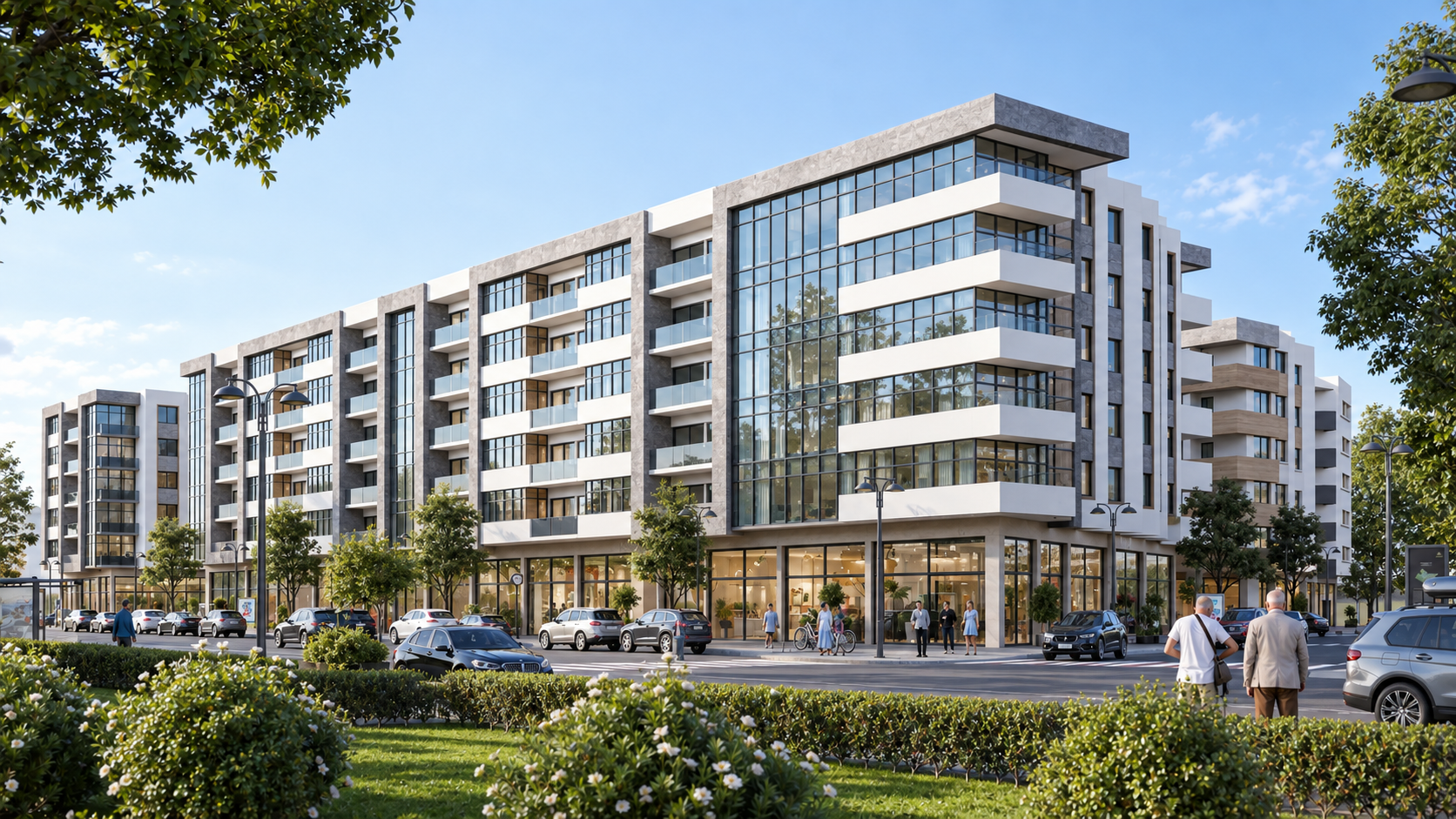
Can a foreigner buy an apartment in Agadir?
Yes, and the legal position is clearer than many buyers expect. Moroccan law does not restrict foreign ownership of urban residential property. A non-resident foreign national can purchase an apartment in Agadir on the same legal basis as a Moroccan citizen, with the same notarial process and the same registration with the national land registry. The main restriction applies to agricultural land, which foreigners cannot acquire directly, and that restriction is unlikely to be relevant to a standard apartment purchase in the city.
But the fact that foreigners can buy does not mean that every apartment is safe to buy. The risks in Agadir are not about nationality. They are about the status of the land, the quality of the title, and the completeness of the documentation. This article sets out what the law permits, what the process requires, and what a foreign buyer should verify before committing.
The legal framework, stated plainly
Moroccan law distinguishes between registered land (immeuble immatriculé) and unregistered land. Registered land has a formal title deed recorded with the Agence Nationale de la Conservation Foncière, du Cadastre et de la Cartographie (ANCFCC). The title deed describes the property, identifies the registered owner, and records any charges, mortgages or other encumbrances. Unregistered land relies on possession and a chain of ownership that is established through other means, often with less certainty.
Foreign buyers should avoid unregistered land entirely. DHAJIA's due diligence guide is explicit: do not treat a property as "clean" because a listing says it has a title. The document, its date, the registered facts and the proposed completion mechanism all matter. The buyer should ask the notary to obtain and interpret current official evidence from the ANCFCC rather than relying on a seller's old copy or a verbal assurance .
For an apartment in a building, the title situation is usually more straightforward than for a standalone villa or a plot of land, because the building will have been registered as part of a development. But the buyer should still verify that the specific apartment, and any parking space or storage area included in the sale, are properly described in the registered rights .
What a foreign buyer can purchase
In practice, foreign buyers in Agadir purchase apartments, new-build residences, villas, and holiday homes. Freehold title is the norm for built residential property. Off-plan purchases are also available through the VEFA framework (vente en état futur d'achèvement), which is the Moroccan equivalent of buying off-plan and includes staged payments tied to construction milestones.
The one clear restriction is agricultural land. A foreign natural or legal person cannot acquire agricultural land directly for agricultural use . If a property outside the urban perimeter is being presented as a residential opportunity, the buyer should confirm its planning classification before proceeding. A rural plot that looks like a bargain may not be buildable, or may not be legally acquirable by a foreigner without a specific structure.
The financial architecture: convertible dirham account
A foreign buyer needs a Moroccan bank account, specifically a convertible dirham account, to complete the purchase. All funds for the transaction should flow through this account. This is not bureaucracy for its own sake. It is the mechanism that creates the traceability required for the purchase to be legally sound and, critically, for the buyer to repatriate rental income and sale proceeds later.
The Office des Changes, which regulates foreign currency flows in Morocco, includes the acquisition of immovable property among recognised forms of foreign investment. When the investment is financed in foreign currency under the applicable rules, the investor benefits from the ability to transfer abroad the income from the investment and the proceeds from sale or liquidation. The convertible account and the bank's documentation of the incoming transfer are the evidence of that .
A buyer who transfers funds informally or without the account structure may still complete a purchase, but they create problems for themselves at the point of resale, when they may be unable to demonstrate the origin of the funds. The practical sequence is straightforward: open the account, transfer the purchase funds from abroad, obtain the bank's documentation confirming the transfer, and ensure the notary records the foreign currency origin in the deed.
The notary and the independent lawyer
Property purchases in Morocco are completed before a notary, who is a public official rather than a private lawyer acting for one party. The notary drafts the purchase contract, verifies the title and the seller's identity, ensures the property is free of undisclosed charges, handles the registration with the land registry, and confirms that taxes and duties are paid.
This does not mean the buyer should skip independent legal advice. The notary serves the transaction and the state, not the buyer alone. DHAJIA's guidance is clear: use your own transaction professionals. The seller, agent and developer may be helpful, but they do not replace advisers accountable to you. An independent lawyer acting for the buyer can review the contract, check the title independently, identify encumbrances, and advise on the specific risks of a given property .
For a foreign buyer unfamiliar with Moroccan procedure, this layer of advice is worth the cost. It is also a safeguard against the most common problem in any property market: relying on the seller's assurances rather than on independent verification.
What to verify before signing
The standard diligence applies to every apartment purchase, but for a foreign buyer it deserves to be explicit.
The title. The notary should obtain a current certificate from the ANCFCC confirming the registered owner, any mortgages or seizures, and the exact description of the property. The buyer should confirm that the apartment, parking space, storage area or terrace are included in the registered rights .
The seller's authority. Verify the identity of the registered seller and, if the seller is acting on behalf of someone else, the validity of the power of attorney. A general power of attorney is not the same as a specific mandate for a specific transaction.
The building. Inspect the common areas, the lift, the roof, the parking areas and the façade. Ask for the minutes of recent condominium meetings and confirm that the seller's charges are current. DHAJIA advises testing water pressure, drainage, electrical systems and air conditioning, and checking for signs of moisture .
The planning position. For a standard apartment purchase, the planning position is usually straightforward, but if the buyer intends to reconfigure rooms, enclose a terrace or undertake material works, the Agence Urbaine d'Agadir can provide a planning-information note reporting the treatment of the land under the planning documents in force. The agency states that the note is informational and is not approval in principle for a project .
The Agadir development context
Agadir is expanding, and that expansion affects the apartment market. Municipal planning for Temsia, one of the communes within Greater Agadir, provides for a development area of around 62 km² with capacity for a future population of 76,585 by 2035. Infrastructure upgrades and new residential districts are extending the city's footprint.
For a foreign buyer, the practical implication is that choice is increasing, particularly in new-build and off-plan segments. But the same rules apply as anywhere: location, developer quality, title verification and realistic rental assumptions matter more than the promise of future growth. A new apartment in an emerging district is not automatically a sound investment simply because the city is growing.
What about buying remotely?
A foreign buyer who cannot travel to Morocco can complete a purchase through a notarised power of attorney granted to a representative in Morocco. This is legally possible and increasingly common. But it requires a specific, time-limited mandate that identifies the property, sets a maximum price, and names the receiving bank account. A general power of attorney gives the agent broad powers that the buyer may not intend .
The power of attorney must be notarised in the buyer's country of residence, then apostilled or legalised through the Moroccan consulate, and translated into Arabic by a sworn translator before use. The process takes time, and it should be built into the transaction timeline rather than left until the last moment.
The honest answer
Can a foreigner buy an apartment in Agadir? Yes. The legal framework permits it, the banking system supports it, the notarial process is established, and there is an active market with apartments available across a range of types and prices.
The requirements are specific but not difficult: a convertible dirham account, funds transferred through official channels, a notary, and independent legal advice for the buyer's side. A foreign buyer who follows those steps can acquire an apartment in Agadir with confidence. A buyer who tries to shortcut them may still complete a purchase, but they carry risks that only become visible later.
The difference between the two is usually a few thousand euros of advice and a few weeks of patience. That is a small price for the protection it provides.
Investment opportunities with Agadir Investment
Agadir Investment works with international buyers seeking exposure to the Agadir property market and the wider Souss region. There are two principal routes.
1. Property investment
Investors can purchase property in Agadir across a range of types: apartments, new-build residences, villas, holiday homes, buy-to-let properties and long-term holdings. Agadir Investment also provides property management services, so owners who do not live in Morocco can have their property managed on their behalf — covering day-to-day operations, guest or tenant handling, and maintenance coordination — without needing to be present.
2. Investment in property development
For larger investors, there is the option to invest directly in the financing and development of property projects. For investments from €5,000,000, Agadir Investment states a fixed, guaranteed return of 7% per year. This is not an estimated or variable return but the stated fixed rate, subject to the applicable contractual terms. Investors considering this route should review those terms carefully with their own advisers before committing.
Contact
To discuss either route, or to request current availability and documentation, contact Agadir Investment at agadirinvestment.com or by email at info@agadirinvestment.com.